Internet of Things
IoT Basics
The Birth of IoT
Let me start this IoT tutorial by introducing the person who coined the term “Internet of Things”. The term “Internet of Things” (IoT) was coined by Kevin Ashton in 1999 in a presentation at Proctor & Gamble. He is a co-founder of the MIT Auto-ID Laboratory. He pioneered the use of RFID (for barcode detectors) in the field of supply chain management. He also founded Zensi, a company that produces energy sensing and monitoring technology. So, let me first introduce you to a quote from Kevin Ashton, which he wrote for the RFID Journal in 2009. This will help you understand the IoT at its core.
If we had computers that knew everything there was to know about things - using data they gathered without any help from us - we would be able to track and count everything, and greatly reduce waste, loss and cost. We would know when things needed replacing, repairing or recalling, and whether they were fresh or past their best. We need to empower computers with their own means of gathering information, so they can see, hear and smell the world at will.
Kevin’s application above will give you an idea of the ideology behind the development of the IoT. Now let’s try to further simplify this term and understand the IoT from its roots. After that, we will move forward and look at the benefits of the IoT.
What is IoT?
When everyone hears about the Internet of Things, what impression comes to mind? The English for the Internet of Things is Internet of Things, abbreviated as IoT. Here “Things” refers to everything around us that can be connected to the network. For example, the clothes you wear, the watch you wear, the household appliances and cars at home, or the house itself, or even the book you are reading; as long as it can be connected to the network, it is a “Thing” in the Internet of Things.
Just as we use the Internet to pass information between each other, the Internet of Things is a mechanism in which “Things” share information and generate useful information by connecting to the Internet, and can operate without human management. They can sense and communicate with each other. Now imagine whether inanimate objects can sense and interact with each other without any human intervention. Sounds magical, doesn’t it?
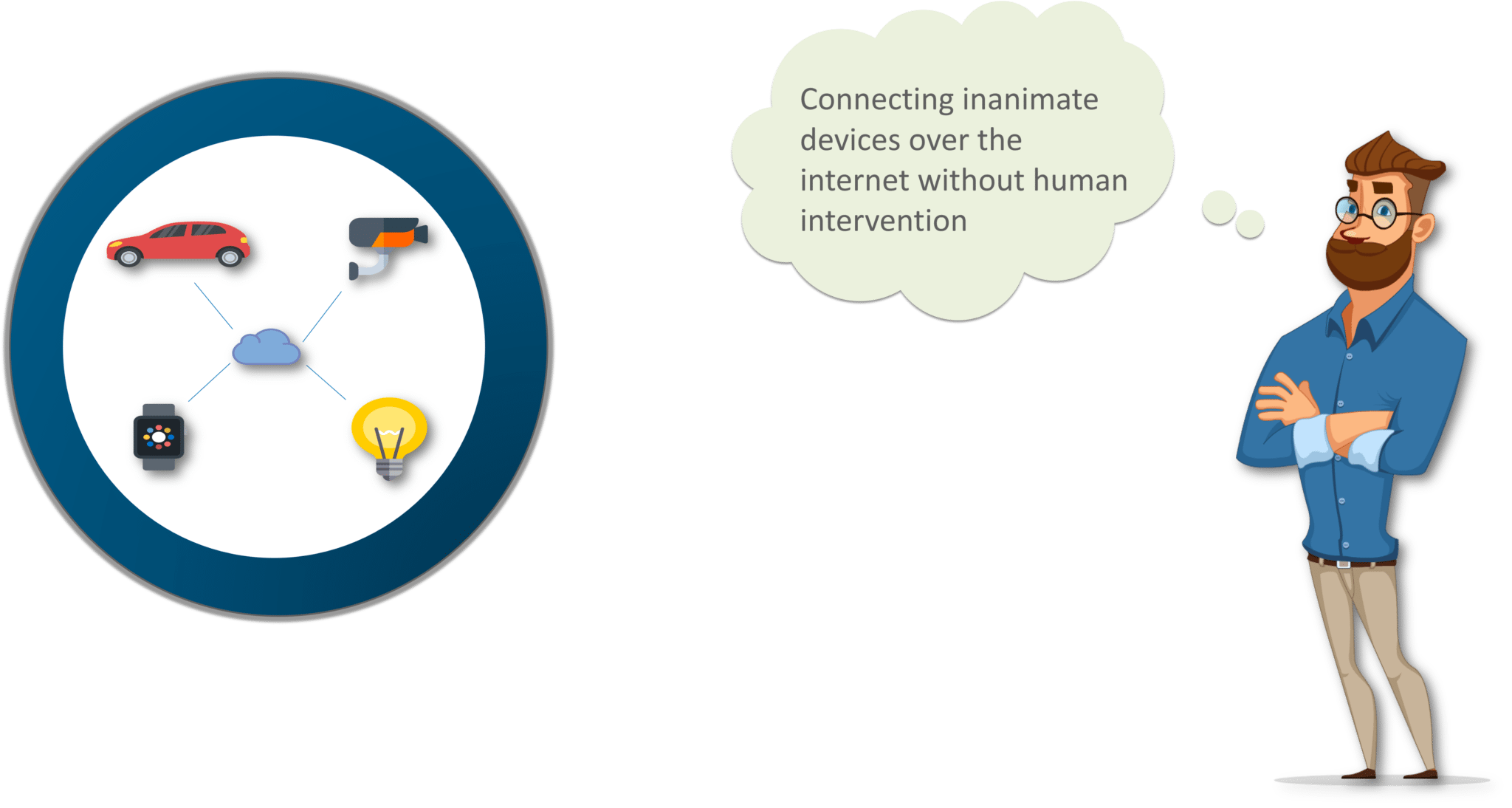
what is IoT?
IoT Architecture
Currently, the IoT architecture is usually divided into three layers: the perception layer, the network layer and the application layer. There are also four-layer, five-layer and seven-layer architectures, but here we use the commonly used three-layer architecture for explanation. The diagram is as follows:
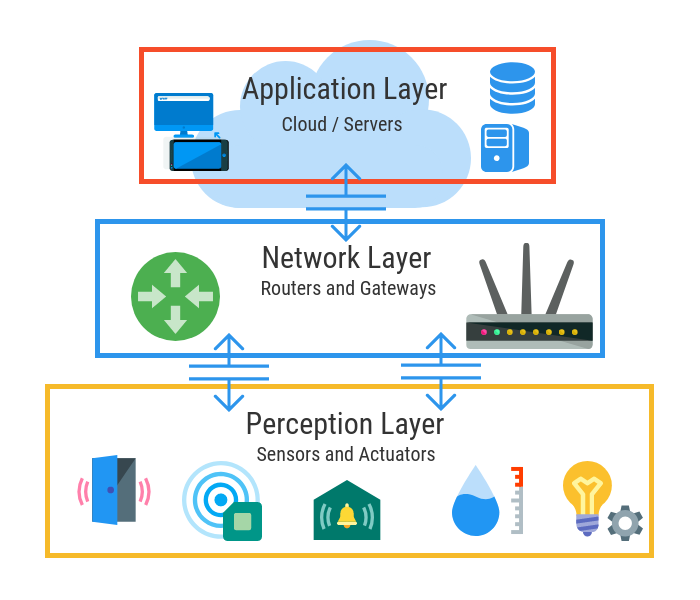
Three-layer IoT architecture
Perception Layer
Sensors, actuators and edge devices that interact with the environment
The perception layer is the skin and senses of the IoT, used to identify objects, sense objects, collect information, and automatically control. For example, when the temperature sensor installed on an air conditioner detects that the indoor temperature is higher than 30 degrees, it collects this information and automatically turns on the air conditioner for cooling; this layer involves various identification technologies, information collection technologies, and control technologies. Moreover, these technologies are used in an intersecting way; various perceptions are some single and some comprehensive. For example, a robot integrates various perception systems. The most common in this layer are various sensors, used to replace or extend human senses to perceive the physical world, and also include the RFID and QR code technologies used in enterprise informatization.
Network Layer
Discovering, connecting and converting devices through the network and coordinating with the application layer
The network layer mainly implements the transmission, routing (deciding the path of information transmission) and control (controlling how information is transmitted) of information. It is divided into two major parts: one part is the IoT communication technology, and the other part is the IoT communication protocol. The communication technology is responsible for physically linking things to things so they can communicate, while the communication protocol is responsible for establishing the rules and unified format of communication.
There are as many IoT communication protocols as communication technologies, such as MQTT, DDS, AMQP, XMPP, JMS, REST, CoAP, OPC UA. The network layer is equivalent to the human brain and nerve center, mainly responsible for transmitting and processing the information obtained by the perception layer.
Application Layer
Data processing and storage that provides professional services and functions for users
I understand the application layer as, with the support of various IoT communication protocols, analyzing the data formed by the IoT at a macro level and feeding it back to the perception layer to execute specific control functions, including controlling the coordination between things, the self-adaptation between things and the environment, and the collaboration between people and things. In my personal understanding, the application layer can be divided into two major parts. One part is the general IoT platform, built on top of a cloud platform, which can be a kind of or a mix of IAAS/PAAS/SAAS. Currently, quite a few enterprises have launched IoT platforms, such as Rootcloud, Baidu Cloud Tiangong, Tencent QQ IoT Smart Hardware Open Platform, Alibaba Link IoT Platform, SAP Leonardo, Amazon AWS, Microsoft Azure, Google Cloud IoT Core. The other part is to generate specific applications on top of this general IoT platform. These applications are similar to mobile phone Apps; the specific applications are how to specifically control these things, how to collect information, and how to control things. These specific application scenarios include:
Personal applications: wearable devices, sports and fitness, health, entertainment applications, sports, toys, parent-child, elderly care;
Smart home: home automation, smart routing, security monitoring, smart kitchen, home robots, sensor detection, smart pets, smart gardens, tracking devices;
Smart transportation: Internet of Vehicles, smart bicycles/motorcycles (helmet devices), autonomous driving, drones, space exploration;
Enterprise applications: healthcare, retail, payment/credit cards, smart offices, modern agriculture, construction;
Industrial Internet: smart manufacturing, energy industry, supply chain, industrial robots, industrial wearable devices (smart safety helmets, etc.);
From the application level, it can be seen that the IoT can really be used everywhere and is everywhere. The ultimate goal of the IoT is to realize the connection of any object at any time and any place, helping humans to have “comprehensive perception, thorough cognition and intelligent processing” of the physical world.
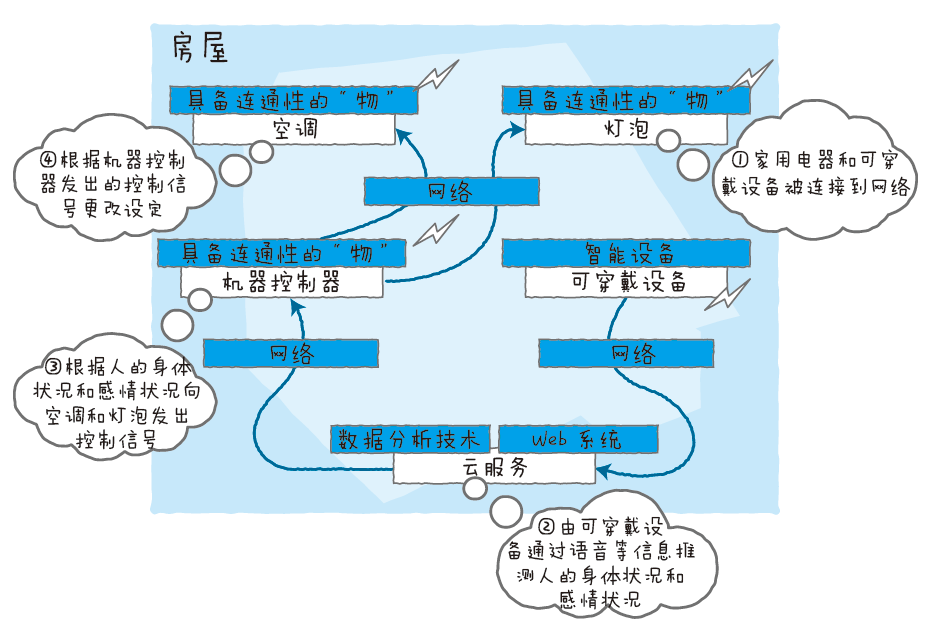
Automatically controlling the environment according to the human body condition - taking smart home as an example
IoT Tutorial
Currently, there are multiple protocols for implementing IoT communication, such as MQTT, REST/HTTP, CoAP, etc. There are also quite a few comprehensive IoT platforms that can be accessed. This chapter focuses on how to access an IoT platform, IoT applications, and how to display communication between things.