1.1. mPython Core 2.0 Introduction
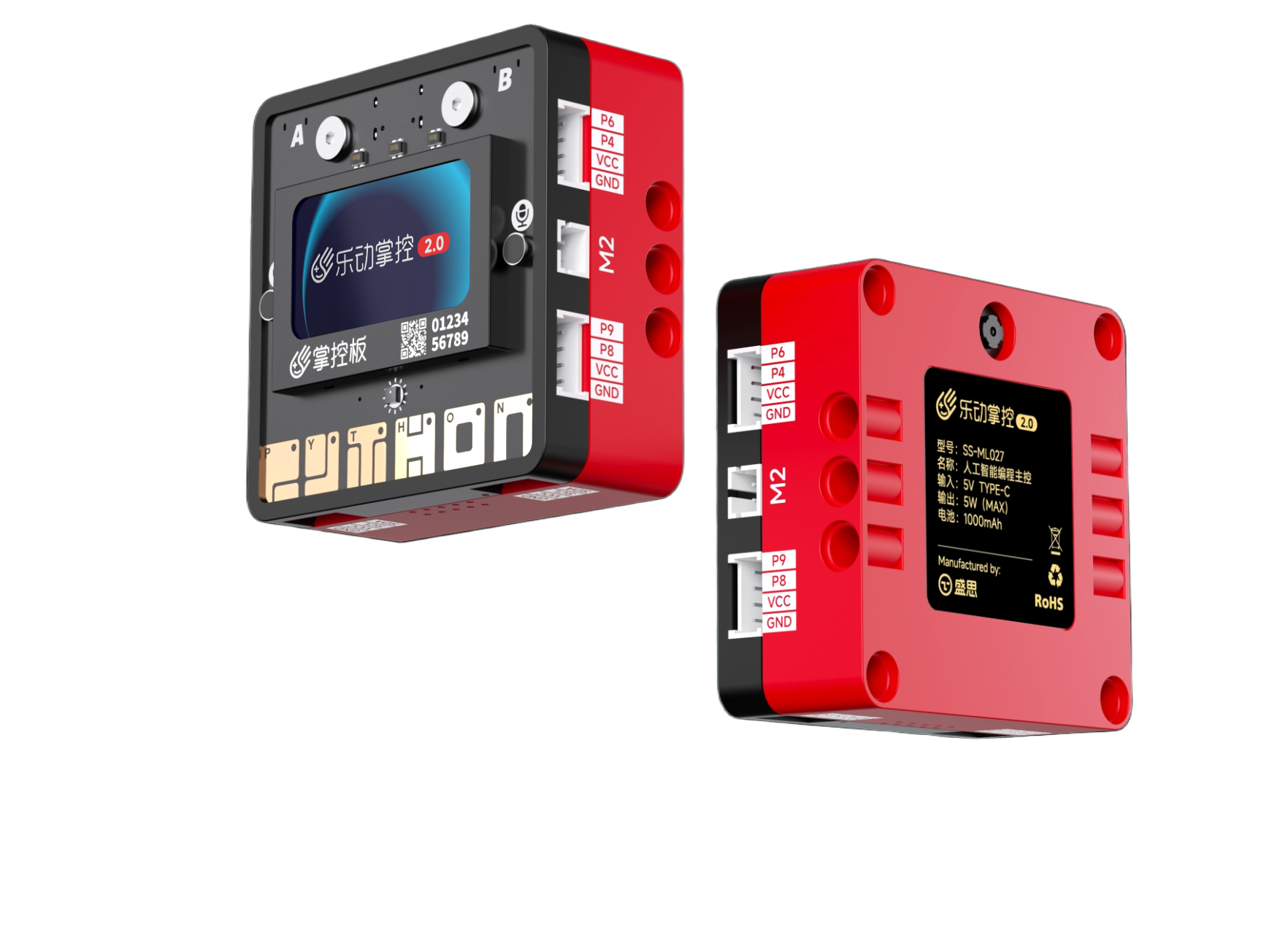
The mPython Board is a teaching aid and learning tool jointly proposed by the Maker Education Expert Committee, Maoyouhui, and a large number of front-line teachers, and developed together with leading enterprises in the maker education industry. It is a piece of open-source hardware born for education, and also a public welfare project.
mPython Core 2.0 is a piece of educational open-source hardware built on the mPython Board ecosystem, with an added expansion board and battery design. It offers rich application scenarios and meets the teaching needs of AIoT and IoT.
It features an onboard ESP32-S3 dual-core chip and supports Wi-Fi and Bluetooth dual-mode communication.
The board integrates a high-definition LCD color display, a 6-axis sensor (accelerometer + gyroscope), a magnetic sensor, a sound sensor, a digital light sensor, 2 physical buttons, 6 touch sensors, and an audio codec chip + speaker. In addition, there is a resistive input interface for easy connection of various resistive sensors. The rich and diverse sensors, compact size, and the combination of Bluetooth and Wi-Fi dual wireless communication enable a variety of IoT application scenarios.
The mPython Core firmware is developed on top of MicroPython and the Espressif IoT Development Framework (ESP-IDF), integrating onboard and commonly used external module drivers, IoT communication interfaces, audio recording and playback, speech recognition, speech synthesis, and large language model application programming. Combined with host programming software such as mPython, it can realize rich application scenarios through programming.
The ESP32-S3 is a high-performance dual-core Wi-Fi & Bluetooth 5 chip launched by Espressif, optimized for AIoT (Artificial Intelligence + Internet of Things) scenarios. It adds vector instructions for accelerating neural network computing and signal processing. AI developers can use these vector instructions through the ESP-DSP and ESP-NN libraries to implement high-performance applications such as image recognition, voice wake-up, and recognition.
The built-in camera can be used for graphics and image AI application programming teaching, such as face detection, face recognition, and object detection.
MicroPython is a streamlined language designed for embedded systems, centered on being lightweight and efficient, adapted to microcontroller resources, operating GPIO/I2C through the mpython module, and compatible with Python 3. It supports REPL interactive debugging and cross-platform porting (ESP32/STM32, etc.), provides dedicated libraries (networking, file system) and asynchronous programming, and balances low power consumption with development convenience. It is suitable for rapid prototyping in IoT, education, and industrial control.
As a piece of educational open-source hardware, it can realize the following application scenarios:
Programming Education
Getting started with graphical programming: Supports graphical programming languages such as Scratch or Blockly, implementing program logic by dragging code blocks. This lowers the barrier to programming, allowing students with no background to get started easily and understand basic programming concepts such as sequential execution, conditional statements, and loop structures.
Advanced Python programming: Also supports the Python text-based programming language, suitable for students who have a certain foundation and want to learn programming in depth. It helps them master more complex programming knowledge such as variables, functions, and classes, and improves their programming skills through practical projects.
Sensor Applications
Environmental monitoring: Uses the light sensor to perceive ambient light intensity, enabling automatic screen brightness adjustment or light switch control. Paired with a temperature and humidity sensor (such as an external DHT11), it monitors ambient temperature and humidity in real time, and can be used to design automatic regulation devices such as smart humidifiers and ventilation systems.
Motion detection: Uses the 3-axis accelerometer to detect object motion states such as tilting, vibration, and shaking, for developing applications like pedometers, motion games, and anti-theft alarms. The magnetic sensor can detect magnetic field changes to implement an electronic compass.
Creative Making
Electronic pet: Students can program the mPython Board’s display, buttons, sensors, and more to create their own electronic pet, implementing functions such as feeding, playing, and growing, which cultivates students’ logical thinking and sense of responsibility.
Mini game development: Uses the mPython Board’s buttons, sensors, and more to develop various mini games. For example, in a racing game, a direction sensor controls the car’s movement. It can also be used to make games like Whac-A-Mole and Snake, enhancing students’ interest in programming and hands-on skills.
IoT Applications
Smart home control: Thanks to its support for Wi-Fi and Bluetooth dual-mode communication, the mPython Board can serve as a control node in a smart home system, connecting and controlling smart appliances, lights, door locks, and other devices to enable remote control, scheduled switching, and scene linkage. For example, it can remotely control the on/off and brightness of home lights through a mobile app.
Smart environmental monitoring system: Multiple mPython Boards are deployed in different areas to form an environmental monitoring network, collecting and uploading temperature, humidity, air quality, and other data to the cloud in real time. Users can view the data through a web page or mobile device, enabling intelligent environmental management.
AI-related Applications
Simple AI function implementation: Combining external sensors with programming to realize some basic AI applications. For example, using a sound sensor and an image recognition module (external) to develop a simple speech recognition control device or image classification system.
Learning AI principles: Students practice related projects on the mPython Board to understand the basic principles and algorithm applications of artificial intelligence, laying a foundation for further study of AI knowledge.