1.1. mPython Board 3.0 Introduction
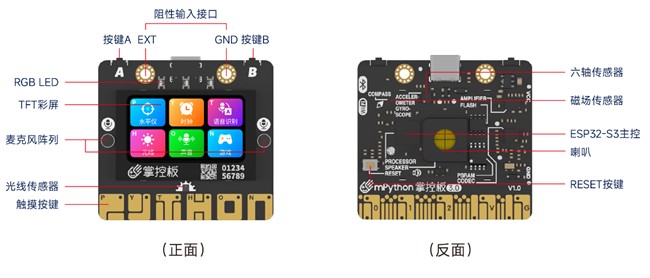
mPython Board 3.0 is an open-source hardware for education, with rich application scenarios that meet AIoT teaching requirements.
The board features a dual-core ESP32-S3 chip, supporting Wi-Fi and Bluetooth dual-mode communication. It integrates a 1.47-inch high-definition LCD color display, 6-axis sensor (accelerometer + gyroscope), magnetometer, sound sensor, digital light sensor, 2 physical buttons, 6 touch sensors, audio codec chip + speaker. In addition, there is a resistive input interface for connecting various resistive sensors. The diverse sensors, compact size, combined with Bluetooth and Wi-Fi dual wireless communication, enable various IoT application scenarios.
The mPython Board firmware is developed based on MicroPython and the Espressif IoT Development Framework (ESP-IDF), integrating onboard and commonly used external module drivers, IoT communication interfaces, audio recording and playback, speech recognition, speech synthesis, large language model application programming, etc. Combined with mPython and other host-side programming software, a wide range of application scenarios can be achieved through programming.
ESP32-S3 is a high-performance dual-core Wi-Fi & Bluetooth 5 chip from Espressif, optimized for AIoT scenarios. It adds vector instructions for accelerating neural network computing and signal processing. AI developers can use these vector instructions through the ESP-DSP and ESP-NN libraries to achieve high-performance image recognition, voice wake-up and recognition applications.
MicroPython is a streamlined language designed for embedded systems, featuring lightweight efficiency, adaptation to microcontroller resources, GPIO/I2C operation through the mpython module, and Python 3 compatibility. It supports REPL interactive debugging, cross-platform porting (ESP32/STM32, etc.), provides dedicated libraries (network, file system) and asynchronous programming, balancing low power consumption with development convenience, suitable for rapid prototyping in IoT, education, and industrial control.
As an open-source hardware for education, it enables the following application scenarios:
Programming Education
Graphical programming introduction: Supports Scratch or mPython and other graphical programming languages, implementing program logic by dragging code blocks, lowering the programming threshold, allowing students with zero foundation to get started easily and understand basic programming concepts such as sequential execution, conditional statements, and loop structures.
Python programming advancement: Also supports Python text-based programming, suitable for students with some foundation who want to learn programming in depth, helping them master more complex programming knowledge such as variables, functions, and classes, and improve programming skills through practical projects.
Sensor Applications
Environmental monitoring: Using the light sensor to perceive ambient light intensity, implementing automatic screen brightness adjustment or light switch control; combined with temperature and humidity sensors (such as external DHT11), real-time monitoring of environmental temperature and humidity, and designing automatic adjustment devices such as smart humidifiers and ventilation systems.
Motion detection: Using the 3-axis accelerometer to detect object motion states such as tilt, vibration, and shaking, for developing pedometers, motion games, and anti-theft alarms; the magnetometer can detect magnetic field changes to implement electronic compass functions.
Creative Making
Electronic pets: Students can create their own electronic pets through programming combined with the mPython Board display, buttons, sensors, etc., implementing feeding, playing, and growth functions, cultivating students’ logical thinking and sense of responsibility.
Mini game development: Using the mPython Board’s buttons, sensors, etc., to develop various mini games, such as racing games where the direction sensor controls car movement; also can make whack-a-mole, snake games, etc., improving students’ programming interest and hands-on ability.
IoT Applications
Smart home control: With Wi-Fi and Bluetooth dual-mode communication support, the mPython Board can serve as a control node in smart home systems, connecting and controlling smart appliances, lights, door locks and other devices, implementing remote control, timed switching, and scene linkage functions, such as remotely controlling home lighting switches and brightness adjustment through a mobile APP.
Smart environmental monitoring system: Deploying multiple mPython Boards in different areas to form an environmental monitoring network, collecting and uploading temperature, humidity, air quality and other data to the cloud in real time. Users can view data through web or mobile, achieving intelligent environmental management.
AI-related Applications
Simple AI function implementation: Combining external sensors with programming to implement basic AI applications, such as using sound sensors and image recognition modules (external) to develop simple voice-controlled devices or image classification systems.
Learning AI principles: Students can understand the basic principles and algorithm applications of artificial intelligence through practicing related projects on the mPython Board, laying a foundation for further AI learning.